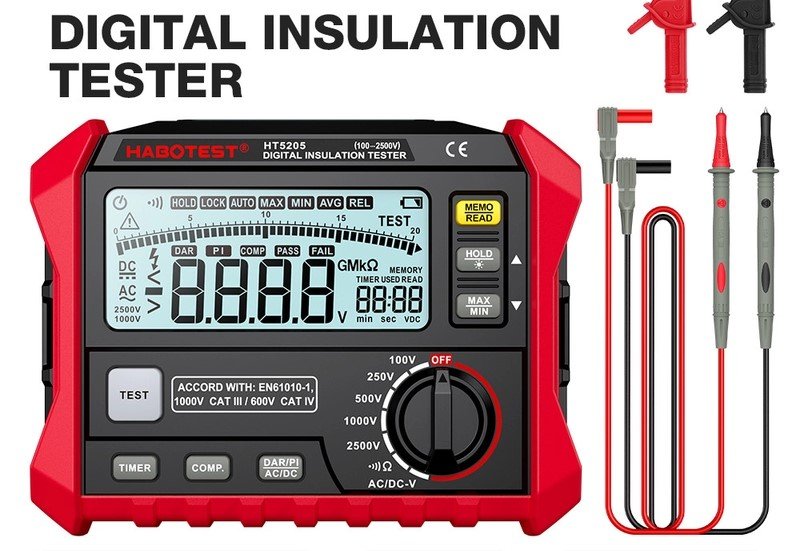
Insulation testers are devices used to measure the resistance of electrical insulation in equipment, cables, and circuits. They are critical in identifying the quality and safety of insulation, ensuring that electrical systems operate without leakage currents or short circuits. Here’s how they function:
- Principle of Operation:
- Insulation testers apply a high DC voltage (typically in the range of 250V to 10,000V) to the insulation material of the equipment or circuit under test.
- They measure the resistance to current flow through the insulation. High resistance values indicate good insulation, while low resistance values signal potential insulation faults.
- Testing Process:
- Voltage Application: A test voltage is applied across the insulation.
- Leakage Current Measurement: The tester measures the small leakage current that flows through the insulation when the voltage is applied.
- Resistance Calculation: Using Ohm’s Law, the tester calculates the resistance RRR as R=V/IR = V/IR=V/I, where VVV is the applied voltage, and III is the leakage current.
- Key Parameters Measured:
- Insulation Resistance: Indicates the effectiveness of the insulation material.
- Polarization Index (PI): Ratio of insulation resistance after 10 minutes to the resistance after 1 minute. It assesses insulation aging and moisture levels.
- Dielectric Absorption Ratio (DAR): Ratio of insulation resistance after 1 minute to resistance after 30 seconds, used to check insulation quality.
Why Insulation Testers are Critical in the Industry
Insulation testers play a crucial role in ensuring the safety, reliability, and efficiency of electrical systems in various industries. Here’s why they are indispensable:
1. Ensuring Safety
- Insufficient or deteriorated insulation can lead to leakage currents, causing electric shocks or short circuits.
- Regular testing helps prevent accidents and ensures compliance with electrical safety standards.
2. Preventing Equipment Failures
- Faulty insulation can result in overheating, equipment malfunction, or catastrophic failures.
- By detecting insulation degradation early, maintenance teams can prevent costly downtime and repairs.
3. Compliance with Standards
- Many industries are required to adhere to strict electrical safety and performance standards, such as IEC, IEEE, and NETA guidelines.
- Insulation testers provide the data needed for certification and compliance audits.
4. Diagnosing Aging and Deterioration
- Insulation naturally degrades over time due to factors like temperature, moisture, and chemical exposure.
- Insulation testing helps monitor aging, allowing for predictive maintenance and replacement planning.
5. Improving Energy Efficiency
- Poor insulation can cause energy losses through leakage currents.
- Insulation testers help identify these issues, ensuring optimal energy use and reducing operational costs.
6. Applications in Various Industries
- Power Generation and Distribution: Testing insulation in transformers, switchgear, and cables ensures uninterrupted power delivery.
- Manufacturing: Motors, generators, and control panels require periodic insulation testing to avoid production disruptions.
- Construction: Ensures the safety of wiring systems in buildings.
- Oil and Gas: Harsh environments demand frequent insulation checks to prevent breakdowns.
Advantages of Insulation Testing
- Early detection of insulation faults reduces maintenance costs and improves safety.
- Non-invasive and quick testing methods ensure minimal disruption to operations.
- Helps establish baseline insulation resistance values for future comparisons.
By incorporating insulation testers into regular maintenance routines, industries can safeguard their equipment, optimize performance, and maintain compliance with safety standards.