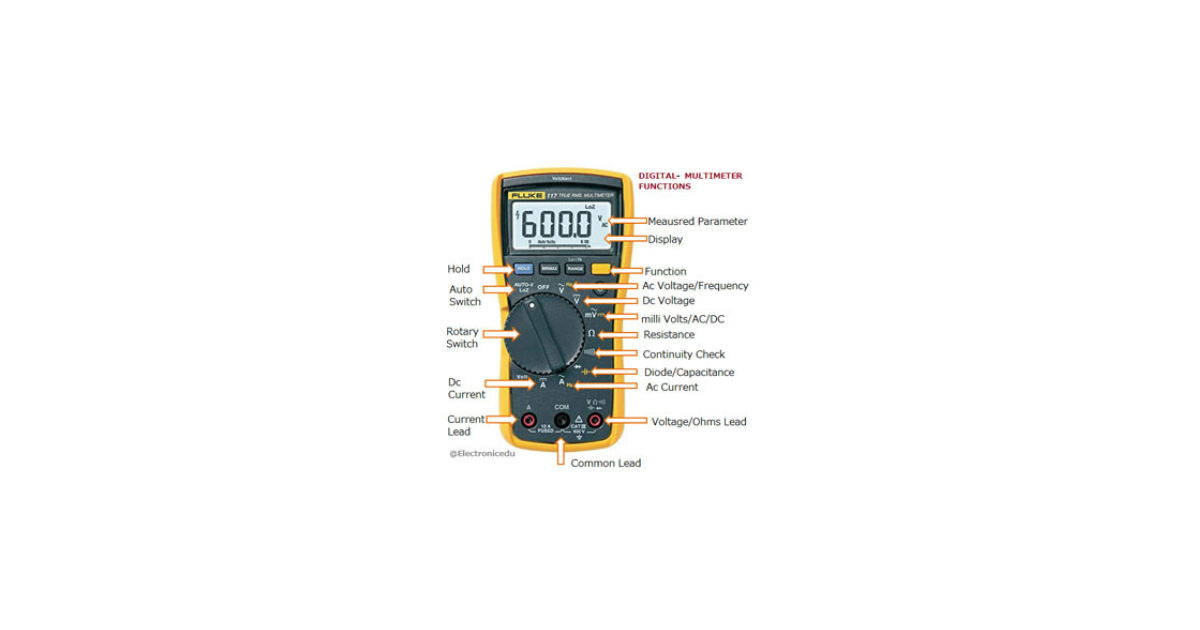
A multimeter is a versatile and essential tool used for measuring various electrical parameters in circuits and systems. It can function as a voltmeter, ammeter, and ohmmeter, and some advanced models can also measure additional parameters like capacitance, temperature, and frequency. Here’s how a multimeter works and the parameters it can measure:
How a Multimeter Functions:
- Voltage Measurement (Voltmeter Mode):
- When set to measure voltage, a multimeter detects the potential difference between two points in a circuit.
- The multimeter is connected in parallel with the component or circuit under test, allowing it to measure the voltage across the two points.
- It can measure both AC (alternating current) and DC (direct current) voltages.
- Current Measurement (Ammeter Mode):
- To measure current, the multimeter is connected in series with the component or circuit where current flow is to be measured.
- The current flows through the multimeter, and it displays the amount of current (in amperes) passing through the circuit.
- A multimeter can measure both AC and DC currents, though measuring high currents may require the use of an external clamp or shunt resistor.
- Resistance Measurement (Ohmmeter Mode):
- In this mode, the multimeter generates a small test voltage and measures the resistance of the component or circuit under test.
- The device is connected across the two points where resistance is to be measured, and it displays the resistance in ohms (Ω).
- This function is also used for testing the continuity of a circuit—if the resistance is close to zero, it indicates a good connection (closed circuit), while infinite resistance indicates an open circuit.
Other Parameters That a Multimeter Can Measure:
- Capacitance:
- Some advanced digital multimeters (DMMs) have a capacitance mode, which is used to measure the capacitance of capacitors in the circuit.
- This is useful for testing the value of capacitors to see if they are functioning correctly.
- Temperature:
- Many modern multimeters come with a temperature measurement function. This is achieved by connecting a thermocouple probe to the multimeter.
- The temperature is displayed in either Celsius or Fahrenheit, which is helpful for diagnosing overheating components or systems.
- Frequency:
- Multimeters with a frequency measurement mode can measure the frequency of an AC signal. This is important for applications where signal frequency is critical, such as in oscillators or communication equipment.
- Diode Testing:
- A multimeter can test the functionality of diodes in a circuit. When set to diode mode, the multimeter applies a small voltage to the diode and measures the voltage drop. A good diode will show a forward voltage drop, and an open or faulty diode will not conduct any current.
- Transistor Testing:
- Some multimeters have a feature to test transistors. They can measure the hFE (current gain) of transistors, which helps in determining if a transistor is functioning properly.
Key Parameters Measured by a Multimeter:
- Voltage (AC and DC): Measures the potential difference between two points.
- Current (AC and DC): Measures the flow of electric charge through a circuit.
- Resistance: Measures the opposition to current flow.
- Capacitance: Measures the ability of a capacitor to store charge.
- Temperature: Measures the temperature of components or systems.
- Frequency: Measures the oscillation rate of an AC signal.
- Diodes: Tests the functionality of diodes and checks their forward voltage drop.
- Transistor: Tests the hFE or gain of transistors.
How a Multimeter Is Used:
- Voltage Measurement: Connect the multimeter’s probes across the component or circuit points where voltage is to be measured.
- Current Measurement: Break the circuit and insert the multimeter in series, ensuring current flows through the meter.
- Resistance Measurement: Connect the probes to the two points where resistance is to be measured and observe the reading.
Types of Multimeters:
- Analog Multimeter: Uses a needle and scale to display measurements. It is less commonly used today but can still be useful in certain applications.
- Digital Multimeter (DMM): Uses a digital display to show measurements. It is more accurate, easier to read, and commonly used in both professional and DIY settings.
A multimeter is an indispensable tool in electrical testing, offering the ability to measure voltage, current, resistance, and often additional parameters like capacitance, temperature, frequency, and even the functionality of diodes and transistors. It is essential for troubleshooting, maintaining, and designing electrical circuits and systems.