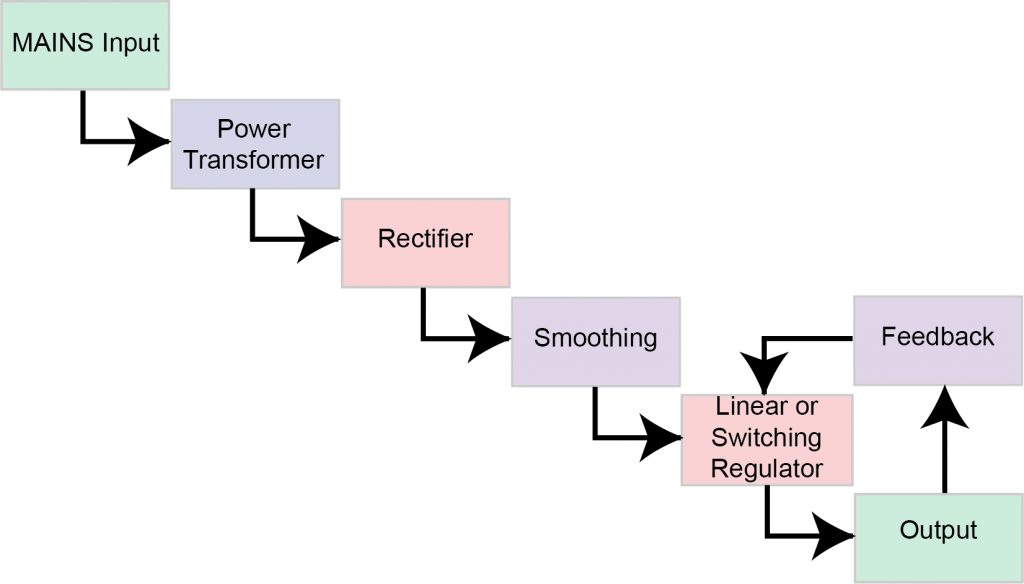
The role of a power supply in an electronic system is critical as it provides the necessary electrical power to operate the system’s components. Its primary functions and significance include:
1. Converting Electrical Energy
- Role: Converts input power (from an AC source like the mains or a DC source like a battery) into the appropriate voltage and current required by the electronic system.
- Example: A laptop power adapter converts 120V/240V AC to 19V DC.
2. Regulating Voltage and Current
- Role: Ensures that the output voltage and current remain stable and within specified limits, even when the input voltage fluctuates or the load changes.
- Importance: Prevents damage to sensitive electronic components due to overvoltage, undervoltage, or power surges.
3. Filtering Noise
- Role: Reduces electrical noise and ripple in the output voltage to maintain the stable operation of the electronic system.
- Example: Precision devices like medical equipment or communication systems require minimal noise interference.
4. Providing Protection
- Role: Incorporates protection mechanisms such as overcurrent, overvoltage, thermal shutdown, and short-circuit protection to safeguard the system and its components.
- Benefit: Enhances the safety and longevity of the system.
5. Ensuring Efficiency
- Role: Converts power with minimal losses to maximize energy efficiency and reduce heat generation.
- Example: Switch-mode power supplies (SMPS) are more efficient than traditional linear power supplies.
6. Supporting Multiple Voltage Levels
- Role: Supplies different voltage levels for various components in a system, such as processors, memory, and peripherals.
- Example: A computer power supply unit (PSU) delivers 12V for hard drives, 5V for USB devices, and 3.3V for logic circuits.
7. Enabling Portability
- Role: Powers portable electronic systems like smartphones, laptops, and tablets using compact and lightweight power sources.
- Example: Lithium-ion battery packs integrated with advanced power management circuits.
8. Facilitating System Performance
- Role: A reliable power supply ensures consistent performance and prevents disruptions caused by power instability.
- Importance: Critical in applications such as data centers, automotive systems, and industrial machinery.
The power supply is the backbone of any electronic system, ensuring reliable operation, protecting components, and optimizing performance. It is tailored to the specific requirements of the system, whether for simple consumer devices or complex industrial applications.